


Tripio
Tripio
Tripio is a free travel and local-discovery app from Tripio, and I found its appeal easy to understand: it aims to put useful travel help in one place instead of making me jump between several unrelated tools. That sounds simple, but it changes how I judge an app like this. A travel companion is not only about attractive destinations or convenient planning. It also needs to make me feel comfortable about what I am doing inside it, what choices I can control, and when I should rely on a specialist service instead.
After spending time with the app, I see it as a practical option for people who want a broad travel resource without immediately committing to a paid download. It is listed as free, with optional purchases ranging from a few dollars to higher-priced items, so I would approach it as an app worth exploring before deciding which extras, if any, are useful to me. Its Everyone age rating also makes it approachable for families and mixed-age travel groups, although parents should still review any purchase prompts before handing over a device.
How Tripio fits into real travel planning
A broad travel tool rather than a single-purpose specialist
The biggest strength of Tripio is its general-purpose position in the Travel & Local category. I would not open it expecting the narrow precision of a dedicated airline app, a hotel booking service, a map application, or a translation tool. Instead, I see it as a starting point: somewhere to collect ideas, orient myself, and decide which part of a trip needs more detailed attention.
That distinction matters. Many travel apps are excellent at one job but become awkward when I need to move from inspiration to practical preparation. A map is good for routes, a booking app is good for reservations, and a review platform is good for opinions, but switching among them can make a simple outing feel like an administrative task. Tripio’s value is in reducing that initial friction. I can begin with the trip itself rather than deciding which narrow tool deserves my attention first.
In everyday use, I would treat it as a companion for the uncertain middle stage of planning. I may know the city but not the shape of my day. I may have a free afternoon and want ideas nearby. I may be travelling with someone whose priorities differ from mine. Those are the moments when a broad resource can be more useful than a highly specialized app that assumes I already know exactly what I want.
Related News

Why WhatsApp Messenger Still Makes Everyday Communication Feel Easy

Jurassic World: The Game Is the Better Dino Tycoon for Strategic Players

Threads in Real Life: Who Should Join, Lurk, or Leave

How SHEIN Turned Shopping Into an Endless Content Feed

How to Make Fortnite Feel Smarter on Mobile

Should You Switch to Microsoft Outlook on Mobile?
A realistic weekend scenario
Imagine that I am staying in a city for two nights and have already arranged transport and accommodation. On the first morning, the weather changes and the outdoor plan no longer makes sense. Rather than opening several apps and searching from scratch, I would use Tripio to reconsider the day as a whole. I could compare the general possibilities available to me, then move to a map or official venue source once I had a clearer direction.
The important point is that I would not make the app responsible for every final decision. I would use it to narrow the field, then check opening times, transport disruption, accessibility details, and reservation requirements through the relevant official source. That workflow is both faster and safer than treating a broad travel app as the sole authority for time-sensitive information.
For spontaneous travellers, this two-step approach is particularly sensible. Tripio can help answer “what could I do?” while a specialist service answers “is it definitely available right now?” Keeping those questions separate prevents a common travel mistake: confusing a useful suggestion with a confirmed arrangement.
Gallery
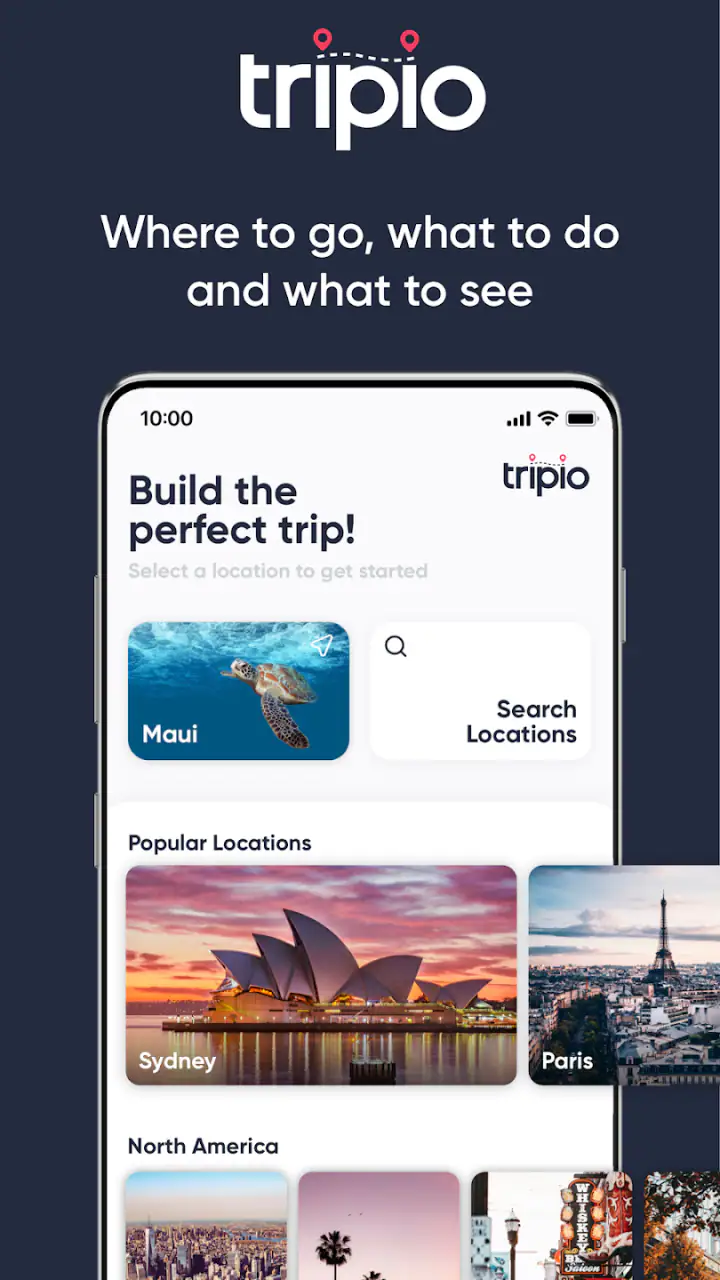
What the current release means for users
The app is currently at version 2.3.0 and supports devices running Android 6.0 or later. That minimum requirement makes it accessible to people using older Android hardware, which is helpful when a spare phone becomes a travel device or when a family member does not upgrade frequently. I would still expect the experience to depend on the phone’s available storage, connection quality, and general performance.
Tripio was released on June 7, 2022, and has grown to over ten thousand installs. Its average rating is four stars from dozens of ratings, with fourteen written reviews shown alongside that score. I read those figures as a sign of an app with a real user base but not one that has reached the broad familiarity of the biggest travel platforms. That makes personal testing more important: the app may suit a particular planning style, but I would not assume it has the depth or coverage of a dominant travel service.
Trust starts with visible choices
Travel apps often sit close to sensitive moments. I may use one while moving through an unfamiliar place, while checking a location, or while deciding whether to share information to make a feature more convenient. For that reason, I pay attention to what the app visibly asks me to do rather than accepting convenience automatically.
My practical advice is to install Tripio before the trip, when I have time to inspect its screens calmly. I would look at each permission request, consider whether it is relevant to the action I am taking, and avoid granting access simply because I am in a hurry. If a feature works without a permission, I would keep that permission disabled. If a request appears necessary, I would still decide whether the benefit is worth it for my situation.
This is not a criticism unique to Tripio. It is a sensible habit for any travel application. A rushed traveller is more likely to tap through prompts without reading them, and a crowded airport or unfamiliar street is the worst place to discover that an account setting or device permission needs attention. Testing the app at home gives me more control over those decisions.
Handling data-sensitive travel moments
Location is the obvious sensitive area in travel software, but it is not the only one. Search history, saved places, account details, payment choices, and travel dates can all reveal something about a person’s movements or plans. I would therefore separate casual browsing from actions that create a lasting record. Looking for ideas is one thing; saving a detailed itinerary or entering payment information is another.
When using Tripio, I would avoid entering more personal detail than the feature genuinely needs. If I am only exploring a destination, I would not rush to create a complete profile. If I decide to use an optional purchase, I would check the purchase screen carefully and confirm that I understand whether I am buying a single item or unlocking something broader. The available in-app purchase range runs from $2.99 to $29.99 per item, so the difference between a small experiment and a substantial charge can be meaningful.
I also recommend reviewing the app after the trip rather than leaving every setting untouched indefinitely. Remove saved information that is no longer useful, revisit account controls if they are available, and check the device’s permission manager. This is a small task, but it gives me a clearer sense of what I have chosen to retain. Trust is stronger when I can make those choices deliberately instead of assuming that convenience and privacy always point in the same direction.
Why the free entry point helps
The free download lowers the risk of trying Tripio. I can see whether its travel approach matches the way I plan before spending money, which is especially valuable for occasional travellers who do not want another permanent subscription or specialist tool. It also makes sense for a group: one person can test the app first and decide whether it adds enough value for everyone else.
At the same time, “free” should not be treated as “cost-free in every situation.” Optional purchases are part of the experience, and the listed range is wide enough that I would pay attention to the wording around each item. I would not buy an add-on merely because it appears at the moment I am excited about a destination. I would first ask whether it solves a problem I actually have, whether the same information is available elsewhere, and whether I will use it beyond one trip.
This is one area where Tripio differs from a completely open web search. Search engines may expose more sources without placing the decision inside one app’s purchase flow, but they also create more noise and require more judgement. Tripio may be more convenient for discovery, while the web or an official provider may be better when I need to verify a price, reservation, cancellation condition, or current operating status.
Account control should match the trip
I would use the lightest account setup that still supports my purpose. For a quick local outing, I would prefer not to build a detailed travel profile unless saving or syncing is genuinely useful. For a longer journey, account-based controls can be worthwhile if they let me preserve planning work or manage purchases consistently. The right choice depends on how much continuity I need between sessions.
That approach also helps separate convenience from trust. An account can make an app easier to use, but it can also make my activity more persistent. Before signing in, I would read the visible explanation of what the account enables and decide whether that benefit matters. If I later stop using the service, I would look for the normal account and device controls instead of assuming that uninstalling the app automatically handles every saved choice.
I would apply the same caution to payment details. Since optional items can be purchased inside the app, I would keep purchases protected by the platform’s normal authentication and would avoid allowing a child to browse unsupervised. The Everyone rating describes the age suitability of the app, not a guarantee that every purchase decision will be appropriate for every household.
Three practical habits that improve the experience
My first useful habit is to use Tripio in two passes. On the first pass, I gather possibilities without trying to finalize the day. On the second, I verify the few options I genuinely want through official sources or specialist apps. This prevents me from wasting time checking every suggestion and reduces the chance that an outdated detail becomes the foundation of my plan.
My second habit is to create a short decision list before opening the app. I might decide that I need something walkable, suitable for a child, indoors, or possible within a limited afternoon. A broad resource becomes much more effective when I give it boundaries. Without them, browsing can become endless, and the app’s range of possibilities may create more indecision than help.
My third habit is to separate discovery from navigation. I would use Tripio to identify an attractive option, then rely on a dedicated map or transport service for the actual route. That trade-off is worthwhile because travel directions change quickly, and a navigation specialist is usually the better place to handle live routing, closures, and arrival timing. Tripio is most valuable before that final route decision, not as a replacement for every tool on my phone.
Where the app may frustrate experienced travellers
Tripio is not the right choice for someone who already has a precise, complex itinerary and wants advanced control over every reservation, ticket, route, and calendar entry. A dedicated booking platform or itinerary manager will usually feel more direct in that situation. The broader the app’s purpose, the more likely I am to need another service for the final operational details.
I would also skip it as my only travel tool if I need dependable offline access, highly detailed accessibility information, live transport alerts, or authoritative booking conditions. Those needs call for services built around the specific requirement. Tripio can still contribute ideas, but I would not make it the single point of failure for a trip where timing, accessibility, or connectivity is critical.
Another possible friction point is the learning curve created by breadth. A general travel resource can feel useful immediately, yet it may take a little experimentation to develop a personal workflow. I would give it a short trial at home rather than judging it during a stressful journey. If I still cannot move from discovery to a clear plan, a simpler specialist app may be a better fit.
My cautious verdict on Tripio
Tripio earns a place on my phone when I want a flexible starting point for travel ideas and local plans. I like the low-risk entry point, the broad positioning, and the possibility of using it before turning to more specialized services. The app is especially suitable for casual travellers, weekend planners, families comparing options, and people who prefer one discovery space instead of beginning with a long list of separate apps.
My recommendation comes with a clear boundary: I would use it as a planning companion, not as an unquestioned authority. I would inspect permissions and account choices, keep personal information to the minimum needed, treat optional purchases thoughtfully, and verify time-sensitive details elsewhere. The strongest way to use Tripio is with deliberate control: let it widen your options, then let trusted specialist sources confirm the details.
For readers who want a single expert tool for bookings, navigation, live updates, or detailed itinerary management, another category-specific app will probably serve them better. For everyone else, Tripio is a reasonable free experiment. Its four-star average and growing audience suggest that it is worth a look, while its smaller footprint means I would personally test it before depending on it for an important journey. In that role, it feels useful without asking me to surrender my judgement, which is exactly the balance I want from a travel app.
Overall, I would recommend Tripio to anyone who enjoys flexible discovery and is comfortable combining it with official or specialist services when accuracy matters. I would not recommend paying for extras automatically, sharing more information than necessary, or relying on it alone when a missed update could disrupt the trip. Used thoughtfully, it can make the early planning stage less scattered while leaving the final decisions firmly in the traveller’s hands.
FAQs for Tripio
What is Tripio and what can I use it for?
Tripio is a travel-focused application designed to help users organize and improve their trips from one place. Depending on the available features, it may assist with discovering destinations, planning itineraries, saving places of interest, and keeping important travel details accessible. Before downloading, check the current app description because available tools and supported travel services can vary by platform and region.
Is Tripio free to download and use?
Tripio may be available as a free download, but some features can require in-app purchases, a subscription, or payment for third-party travel services. The app itself may not include the cost of flights, accommodation, tours, transportation, or other bookings made through linked providers. Review the pricing information shown in the Google Play Store or Apple App Store before creating an account or confirming a purchase.
Does Tripio require an account or an internet connection?
Some Tripio functions may be accessible without registration, while personalized planning, synchronization, saved trips, reservations, or social features can require an account. An internet connection is generally needed to search destinations, load updated information, and access online services. If offline access is supported, download your itinerary or relevant travel information in advance, since coverage and availability can differ during your journey.
Is Tripio useful for planning international trips?
Tripio can be useful for international travel if it supports the destinations, languages, currencies, and travel services you need. However, users should not rely on the app as their only source of information. Visa requirements, entry rules, transport schedules, local restrictions, and safety guidance can change quickly, so confirm important details with official government websites and service providers before traveling.
What privacy and permission considerations should I know before installing Tripio?
Before installing Tripio, review its privacy policy and the permissions requested on your device. A travel app may ask for access to location, notifications, storage, or calendar functions to provide maps, reminders, recommendations, or itinerary tools. Only grant permissions that match the features you intend to use, and check how the app collects, stores, shares, and allows you to delete personal travel information.
Pros
- Simple interface makes trip planning quick and approachable.
- Useful for discovering attractions and activities in unfamiliar destinations.
- Can help organize travel ideas in one convenient place.
- Suitable for both spontaneous outings and detailed itineraries.
- Travel suggestions may inspire experiences beyond typical tourist spots.
Cons
- Information quality may vary between destinations.
- Some features may require an internet connection while traveling.
- Recommendations may not always match personal interests or travel style.
- Availability of attractions and activities can change without notice.
- The app may offer limited value in destinations with sparse coverage.


